Croc wise in Queensland

Shelley Wright • June 20, 2024

Cruising in croc country

After moving to the Central Queensland coast many decades ago, learning to sail seemed a good idea. My husband-to-be and I bought a small neglected Hartley TS16 (trailer sailer), patched up the large hole in its hull, and set about teaching ourselves to sail the hard way, dodging coal ships and running aground on nearly every sand bank in Gladstone Harbour. 


Over a few drinks at the local sailing club one night, an old yachtie warned us to be careful sailing around the ‘Narrows’, the stretch of water surrounded by mangroves that runs between the mainland and Curtis Island. He told us there were crocs. 

Fresh from the lush green hills of New Zealand, where the most terrifying creature is a wētā (a large cricket), we figured he was joking and took little notice. 


However, it wasn’t long before the chilling sound of a throaty growl while we were out on our little boat near the mangroves, and the sight of mud slides at low tide, had us taking him seriously.


The estuarine crocodile 


The estuarine, or saltwater, crocodile (Crocodylus porosus) is the largest of all living reptiles, with males growing to five metres or more. They are found from India to northern Australia, and across to Vanuatu and the Solomon Islands.  An ambush predator, estuarine crocodiles usually spend the northern Australian wet season in rivers and swamps. Breeding and nesting occurs between October and April. In the dry season (May to October) they move downstream into estuaries and coastal areas. 


The estuarine crocodile population in northern Australia was decimated by widespread, unregulated, hunting last century. By 1971, 95 per cent of the population had been killed. Since then, full legal protection across all Australian states has seen a rapid recovery of croc numbers with current populations estimated at 100,000 to 200,000 adults. 


Yachties are reporting more sightings. This could be the result of increasing crocodile numbers, increasing cruising yacht numbers, the advent of social media or, more likely, a combination of all three. Habitat destruction is also resulting in more croc interaction with people.


Estuarine crocodiles generally hunt at night, their night vision is excellent. They are more active during the summer months and spend more time in the water at this time. Estuarine crocodiles are highly mobile and can swim up to 25-30 km per hour in short bursts. In a study of 20 satellite tagged crocodiles in northern Australia, eight were tracked into the open ocean, with one travelling 590 km in 25 days.


In Queensland, from 1985 to present, there have been approximately 36 attacks on humans by crocs in the wild.  Of these, 11 were fatal. All were in the far north. 


Staying safe in ‘croc country’


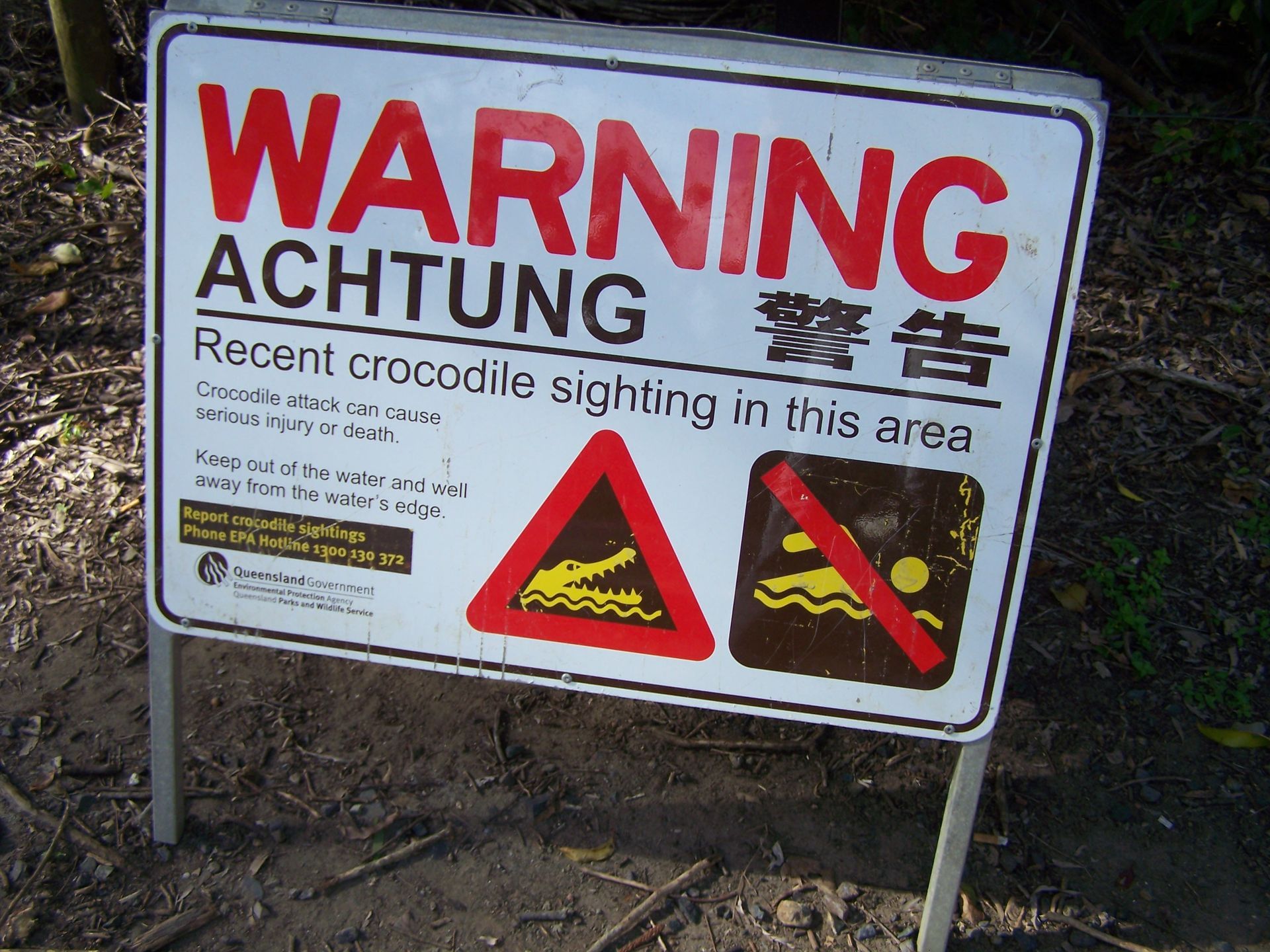
Many first-time cruisers heading north along the Queensland coast are unaware how far south estuarine crocodiles can occur. ‘Croc country’ is generally recognised as beginning at the Boyne River, near Gladstone, however, they may be present wherever there is suitable habitat and they have been sighted as far south as the Great Sandy Strait.  Particular care should be exercised when travelling or anchored in close proximity of known croc habitat, for example large rivers or estuaries, and mangrove areas around islands and channels. Common sense should prevail when using these waters.


Crocodiles can, and do, make their way out to the clear water of reef islands. While Lizard Island, a mecca to cruising yachties heading up the Cape York coast and northern Great Barrier Reef, has always been considered relatively ‘croc-free’, crocs up to 2.5 m long are sighted periodically. In 2016, a snorkeller at Lizard was bitten by a 2 metre crocodile while swimming at night. 


While many people cruise the Queensland coast for years without ever seeing a croc, in reality there is potential to encounter crocs anywhere within the Great Barrier Reef Marine Park or adjacent waterways. Estuarine crocodiles are potentially extremely dangerous, warning signs should not be ignored and the absence of a sign should not be taken as an absence of crocs.


Some tips for staying safe in croc country include:

  • Stay well back from croc slide marks (usually visible on mud banks) and away from the water’s edge near slides.
  • Never clean fish or discard scraps near boat ramps or beaches. Never feed crocs, it is illegal to do so. 
  • Keep vehicles and boats at least ten metres away from a croc in the wild – it is illegal to approach any closer.
  • Keep arms and legs within your boat. If fishing from a beach, stand several metres back from the water’s edge. 
  • Avoid being in or around the water at night.
  • Estuarine crocodiles notice routine. If you are anchored somewhere for more than a day vary your activities and the time you undertake them.

All estuarine crocodile sightings in Queensland (particularly in populated areas) should be reported to the CrocWatch hotline 1300 130372. 


A summary of current sightings and ‘crocodiles of concern’ can be found on the CrocWatch website:

https://environment.des.qld.gov.au/wildlife/animals/living-with/crocodiles/sightings


By Julie Porter May 20, 2026
Gathering on the Bay 10th Anniversary!
May 10, 2026
The Pacific Rally 2026 is officially underway, with a fleet of nearly 190 vessels registered so far, and preparing to depart from key staging points across New Zealand & Australia in early May, marking the start of the South Pacific cruising season. Organised by Island Cruising, the flexible Pacific Rally has grown to become one of the largest organised yacht rallies in the world, attracting a diverse fleet ranging from 30-foot sailing yachts to 75-foot yachts & powerboats. Unlike traditional rallies, the flexible format means people are free to choose their own departure date, route and destinations, while still being able to tap into all the Island Cruising support and resources along the way. Over the last six months, rally participants have enjoyed regular online training sessions to help them get prepared for the adventures ahead. Then during the last two weeks, they have gathered to enjoy a range of briefings and social events at the Boat Works on Queensland’s Gold Coast, Marsden Cove Marina, and Bay of Islands Marina in New Zealand. There are additional vessels joining the rally along the way, including yachts crossing west from French Polynesia. Popular cruising grounds for rally participants include Tonga, Fiji, Vanuatu, and New Caledonia, with many vessels planning onward passages to Asia or returning to New Zealand or Australia later in the season. “The Pacific Rally is about giving people the confidence to set sail,” says Viki Moore, Managing Director of Island Cruising. “We work hard to ensure participants are well-prepared, well-supported, and never feel like they are out there alone. That sense of connection makes a huge difference to both safety, fun and the overall experience.” Moore also works closely with the border officials across the Pacific to ensure everyone is prepared for the arrival formalities for each country along the way. Participants benefit from a comprehensive support framework, including pre-departure training, weather guidance, communications support, detailed guides on where to go, and access to a wide network of trusted marine partners. A strong community network — both online and on the water — is central to the rally, enhancing safety while creating a shared and social cruising experience. A key focus of the rally is responsible and respectful cruising. Through its partnership with Citizens of the Sea, some rally participants volunteer to collect Ocean eDNA samples on their passage and everyone is encouraged to engage with local communities in a culturally aware manner and contribute to environmental stewardship efforts throughout the Pacific. The success of the Pacific Rally is supported by an extensive network of marine industry partners across New Zealand and Australia & the South Pacific. These partners play a vital role in preparing vessels before they set sail and along the way, ensuring they are equipped with the knowledge, equipment, and confidence needed for the journey ahead. As the fleet prepares to head offshore, anticipation is building for another season of cruising, connection, and exploration across one of the world’s most iconic sailing regions. For more information, visit: www.islandcruising.nz Facebook page https://www.facebook.com/islandcruising.nz More information about Citizens of the Sea - https://www.citizensofthesea.org/ Photo: Viki and Cecile are joined by partners from Yachting World Port Vila and Vuda Marina for the briefings at the BoatWorks
By Fiona Bengtsson April 29, 2026
On improvements, unintended projects, and a boat that keeps evolving By Fiona Bengtsson
April 29, 2026
In a unique joint research partnership, world record explorer Lisa Blair OAM, the Australian Composites Manufacturing CRC (ACM CRC), UNSW Sydney, and Steber International are announcing the launch of a solution-focused research project: Sustainable Composites for Next Gen Boat Hulls. This two-year, $1.9 million research partnership aims to investigate the viability of Basalt Fibre (derived from volcanic rock) and current bio-resins as a scalable solution to outperform fibreglass and provide a circular solution to the growing industry problem. Following the initial research, Lisa Blair will build her new expedition yacht from these sustainable materials before setting off for her next record. Lisa is announcing her new world record attempt: ‘The Arctic Impact Project’. Lisa will be sailing in July 2027 to become the first person to sail solo, nonstop and unassisted around the Arctic Circle in one season. The 8,000 nm journey will see Lisa tackle freezing conditions, dodge icebergs and spend an estimated 3 months solo at sea. Cover photo: Research Kick Off Meeting. Left-Right Scientia Professor Gangadhara, Luke Preston, Lisa Blair OAM, Jessica Mevel Soenecs. Insert Photo Alan Steber MD Steber International who was unable to attend but is a valued partner. Below: Lisa Blair OAM.
By Anne Barnes June 20, 2024
Home is changing
By Shelley Wright June 20, 2024
WWSA's Shelley Wright shares ten of her favourite books by women solo sailors
May 23, 2024
NEW SAILING RECORD COURSE SET IN NZ BY SAILOR LISA BLAIR
May 20, 2024
Orcas, giant swells, and stunning sunsets accompany Lisa Blair on the home run for new sailing record
May 6, 2024
Record-breaking solo sailor Lisa Blair will embark on a new World Record sailing attempt tomorrow, April 7 th at 8am (NZST) to establish an Auckland to Auckland, New Zealand, sailing record over more than 2,200 nm on a circumnavigation not yet recorded. Only last month she set a fastest time record for Sydney to Auckland as the first woman and solo monohull record of 8 days, 3hrs and 19 minutes, taking over 4 days off the existing record, to be ratified by World Sailing Speed Record Council (WSSRC). Lisa will steer her yacht Climate Action Now from Westhaven Marina to a start off Rangitoto Island, supported by the Royal New Zealand Yacht Squadron (RNZYS), then head north out to Great Barrier Island beginning a journey rounding New Zealand’s northernmost point at Cape Reinga where two oceans collide as she crosses from the Pacific Ocean to the Tasman Sea. The public can view her live tracker on the website and social posts each day. The anticipated 18-day voyage will take her down the west coast of New Zealand’s North Island heading into a predicted storm force wind system around New Plymouth where the imposing Mount Taranaki impacts the weather system before she crosses Cook Strait and into headwinds all down the West Coast of the South Island. As she reaches the south Fiordland region she will have no shelter from the Southern Ocean storms and dangerous swells before pressing south to round Stewart Island and the Southwest Cape where the sea depth dramatically reduces from 5km to 50 metres on the shelf causing noted rogue waves. Turning northwards past Dunedin headwinds are again predicted and major commercial fishing grounds with long line nets will provide a hazard before heading into major commercial and recreational boating regions all the way up the coast. This will test her resilience with 20-minute micro sleeps the whole journey home to avoid dangerous traffic and hazards. The record, to be adjudicated RNZYS in collaboration (CYCA) and WSSRC, will require her course to enclose the whole of New Zealand including all rocks and islands lying 8nm offshore – a rhumb line distance of 2,200nm, although her journey will be much longer to sail. Lisa is an ardent promoter of climate action with her several world record journeys involving the collection microplastic samples for scientific analysis and her awareness raising of ocean pollution issues as well as advocacy for solutions and change for the health of the ocean. “I want to see a happy and healthy planet and people won’t protect what they can’t understand so I try to share my love of the ocean and this planet with my records. I think adventurers have a responsibility to become story tellers and communicators,” said Lisa, who was named 2022 Australian Geographic Adventurer of the Year. Lisa’s sustainability journey first started in 2012 while sailing around the world in the Clipper Round the World Yacht Race. “We were more than 20 days from land sailing across the Southern Ocean from South Africa to New Zealand. I was at the helm looking out when we crested a wave and there, off our bow was a Styrofoam box floating past. We were thousands of miles from land in the most remote regions of the planet and I was seeing plastic. I couldn’t believe it.” In 2015 Lisa launched her Climate Action Now message and began collecting post it note messages from people in the public. Lisa’s yacht Climate Action Now is adorned with thousands of messages of environmental actions from members of the community. Lisa is the current world-record holder for sailing solo, non-stop and unassisted around Antarctica in 2022, breaking the record by 10 days to add to her 4 previous world records and now 2 new pending Sydney to Auckland records. In exciting news, Lisa has teamed up with film-makers Nathaniel C. T. Jackson and James Blannin-Ferguson to make a feature-length documentary tracking her ambitious and treacherous solo voyage around Antarctica. Screenings of the world premiere of Ice Maiden will be at the Doc Edge Festival which plays in Christchurch (19-30 June), Auckland (3-14 July), Wellington (3-14 July) and then nationwide via the virtual cinema (15-31 July). For more information visit docedge.nz Lisa's webpage is: www.lisablairsailstheworld.com
April 8, 2024
Sydney to Auckland arrival due today!
Show More